In our final installment of the Firm AI Principles series, we discuss what truly differentiates a firm and gives it competitive advantage: its collective experience over time, and unique approach to serving clients and running the business of the firm.
Principle 7: The firm’s memory and methods are the moat.
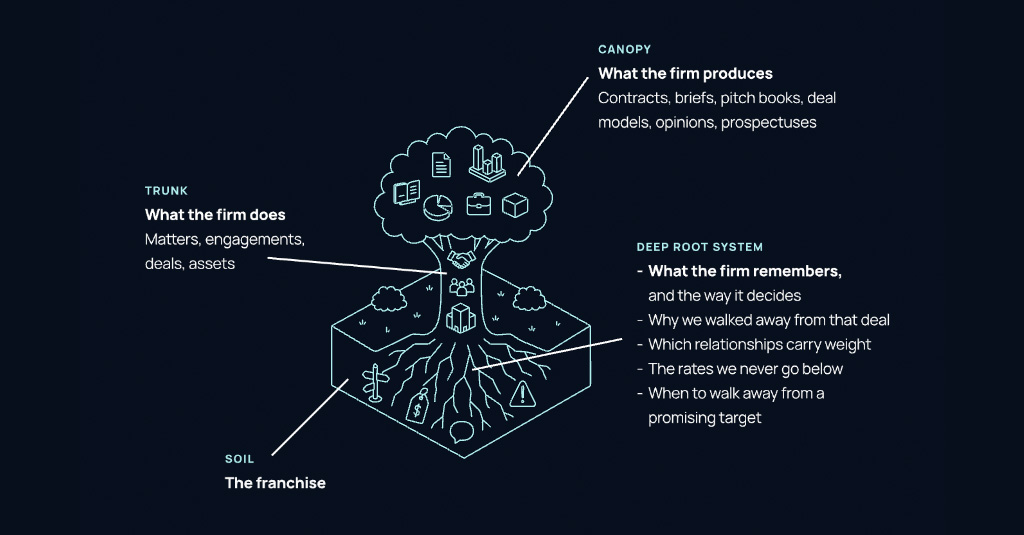
Two things compound inside a great firm: its memory of every matter, deal, engagement, relationship, and decision it has ever made, and the unwritten methods by which it turns all of that into the next decision. Horizontal AI sees neither. Firm AI is how the firm finally captures both.
The firm’s most unique experience is encoded in the record of every decision it has ever made — every deal walked away from, every lateral hired or passed over, every fee arrangement held or broken, every conflict cleared or escalated, every relationship deepened or allowed to lapse — and the years of partner and MD correspondence that captures the reasoning behind each one. From a firm growth standpoint, this is the strategic asset that encodes what the firm actually knows.
The firm’s memory is also not a single pool. It is a governed Venn diagram of segments — matter teams, deal teams, fund vehicles, audit engagements — each with its own access list, walls, and retention posture. A useful Firm AI reads across segments where permitted, redacts where it must, and elevates cross-firm patterns (methodology, expertise, opportunity benchmarks) without violating any segment’s promise to its client, LP, or regulator. Segment-aware memory is what lets the firm draw on its own history without betraying the rules under which the history was built.
What distinguishes one firm from another is the method. The method is the franchise.
But memory is more than artifacts. It is method. Every firm has a way of making decisions that lives nowhere written down: the senior partner’s instinct for which deals are worth the reputational risk, the managing partner’s unwritten rules about which clients earn reduced-rate work, the fund CIO’s pattern for when to walk away from a promising target. Legal advice and deal-making are commodities. What distinguishes one firm from another is the method. The method is the franchise.
For a century, the method has been passed down in apprenticeship — corridor conversations, the editing of a first-draft memo in red pen, the way a senior partner reframes a push-back. There was no way to codify it. Firm playbooks are the first vehicle that can. Authored by the firm, run by expert coworker agents, governed by the firm’s compliance posture, improved every time used. Codified, the method is not a replacement for culture; it is the way the firm scales its culture without diluting it. A firm that does this keeps its method when its senior partners retire. A firm that does not watches the method walk out the door.
And the method improves itself by being used. Take a private capital firm that, for the first time, screens all of its inbound deals against its own thesis. Every deal it reviews, and every call it makes to pursue or pass, becomes part of the record. The firm builds a proprietary history of its own judgment — what it chased, what it declined, and why — that no competitor has and no model can supply. The next screen is sharper than the last, not because the model improved, but because the firm’s own decisions trained it.
This is the flywheel, and it is why the moat deepens over time. The firm gets smarter about itself the longer it operates. When the next generation of foundation models arrives, the firm that has compounded years of its own judgment is years ahead. Horizontal AI cannot compound inside the firm the same way, because it cannot see what makes the firm a firm. Firm AI compounds. The moat gets deeper every quarter.
Learn more about Intapp Celeste, the engine behind Firm AI.