Ask Intapp Celeste the same question as a colleague, and you’ll get a slightly different answer — one tailored just for you.
That’s the result of how Celeste handles memory — and it’s different from how most AI systems approach the problem. Generic AI memory tends to fall into one of two traps — and both get worse at firm scale:
- Generic AI remembers everything indiscriminately, creating a large, unprioritized repository that the system struggles to use efficiently when tailoring future conversations.
- Generic AI remembers nothing, so every conversation starts from zero.Neither works for a professional firm where the same assistant serves dozens of people with different clients, work, and permissions.
Neither works for a professional firm where the same assistant serves dozens of people with different clients, work, and permissions.
Celeste’s answer is to make memory personal by design. We’ve studied the legal and financial services domains to understand the most important pieces of memory to track — and that research shaped what Celeste looks for. As you work, Celeste builds a picture of you across three dimensions: what you’ve solved before, how you like work done, and who you are — carrying that knowledge forward from one conversation to the next.
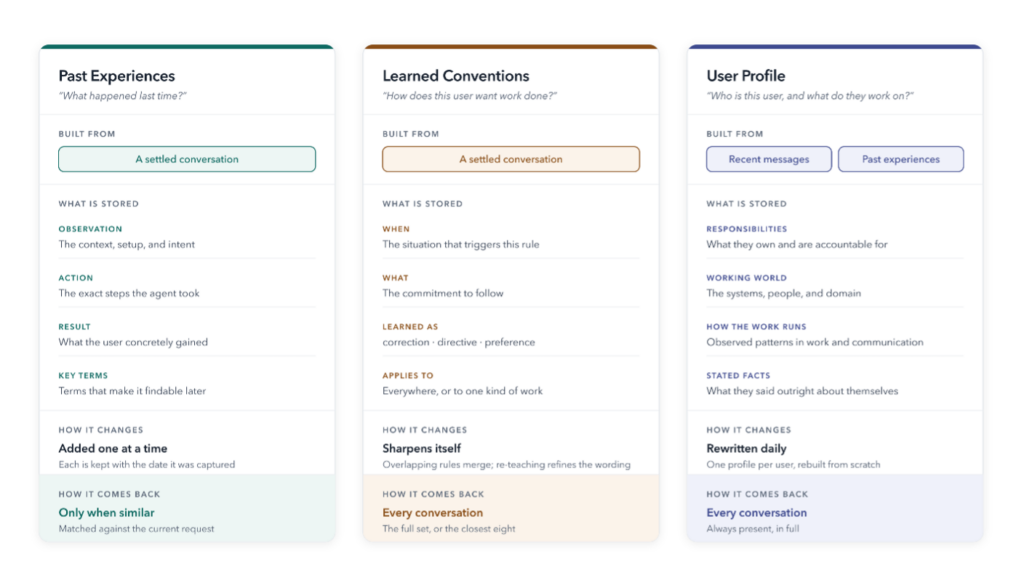
The 3 memory types
Celeste doesn’t treat every conversation as something to remember. Instead, Celeste waits until a conversation has ended before deciding what, if anything, is worth retaining. Short exchanges aren’t retained, and nothing is captured while a conversation is live.
Retained information can be categorized into three types of memory: past experiences, learned conventions, and your user profile. Together, they give Celeste the context it needs to ground and personalize every answer it provides.
1. Past experiences
Celeste records every problem it helps you solve, so it can recognize similar work when it comes up again. Each record captures four elements: the observation (the context, setup, and intent), the action (the exact steps taken), the result (what you concretely gained), and key terms that make it searchable.
For example:
- Observation: You previously requested a pre-meeting brief on a portfolio company but had no meetings on your calendar.
- Action: Celeste checked your calendar, found no meetings, and offered to build the brief from a company name instead.
- Result: Celeste produced the brief from a manually supplied name and established that the workflow needed either a calendar event or a company name to proceed.
Not every conversation produces an experience record — only the ones where something actually got solved. Each record is timestamped, and any figures captured are marked as true at the time of recording rather than as current fact. That way, Celeste re-checks live data instead of surfacing a stale result.
2. Learned conventions
A convention is a standing instruction about how you want work done, inferred from how you’ve corrected or directed Celeste previously. Each one pairs a commitment (what Celeste will do) with a trigger (when Celeste will do it).
For example:
- Trigger: Drafting a client-facing summary
- Commitment: Lead with the fee arrangement, not the timeline
- Celeste learns: Carry that structure forward for future client-facing summaries
Conventions are captured three ways: You corrected Celeste, you instructed it directly, or you expressed a standing preference. Some conventions apply everywhere, while others are scoped to a specific kind of work. However, most conversations don’t produce any new conventions at all, keeping your preferences focused rather than overprescribed.
Conventions also refine over time. Teaching Celeste the same thing across two conversations produces one sharper convention, not two redundant ones. Re-teaching sharpens the existing wording rather than duplicating it.
3. User profile
Your user profile is a short standing description of who you are and how you work, built across four dimensions: responsibilities (what you own and are accountable for), working world (the systems, people, and domain you operate in), stated facts (what you have said directly about yourself), and working patterns (inferred preferences based on how you typically work and communicate).
For example:
- Responsibilities: Owns time-entry compliance for the London office
- Working world: Works in Intapp Time and DealCloud across several concurrent matters
- Stated facts: Works in Eastern Time
- Working patterns: Prefers tables to prose; repeats a request rather than rephrasing it
The personal profile is also re-evaluated and rebuilt daily, so it reflects who you are now — not who you were six months ago. Most AI memory works the other way: Details accumulate until someone prunes them by hand. Celeste does the upkeep for you.
Personalization without compromise
Celeste’s memory accumulates from ordinary work, conversation by conversation. It’s continuously rebuilt and re-evaluated, so details that are no longer relevant naturally fall away. And when you need to teach Celeste something new, you can simply correct it in the moment, within the conversation where it happens.
That means no re-explaining context, no re-stating preferences, and no correcting the same mistake twice.
None of this comes at the expense of governance. What you teach Celeste is scoped to you alone. Two people asking the same question will receive different answers, shaped by their own memories and preferences — not each other’s.
Personalization and governance aren’t a trade-off. With Celeste, governance is what makes personalization possible.
Key takeaways
- Zero setup: Memory automatically builds itself from ordinary work.
- Personalization: Responses are tailored to each user’s own context and experience, never another user’s.
- Self-refining: Profiles rebuild daily and conventions sharpen with re-teaching, keeping Celeste aligned with your evolving needs and working style.
- Governance first: Personalization never surfaces someone else’s privileged or private context.
Discover what Celeste can do and request a demo to see it in action.