Last week, we introduced a blueprint for a new category of AI that we believe will drive business success for professional and financial services going forward. Mind your business. Not just your practice. is our complete statement on what Firm AI is, why it exists, and what we’re building toward with Intapp Celeste.
Today, we share the first of seven principles that underlie our argument for Firm AI.
Principle 1: A firm is not a company
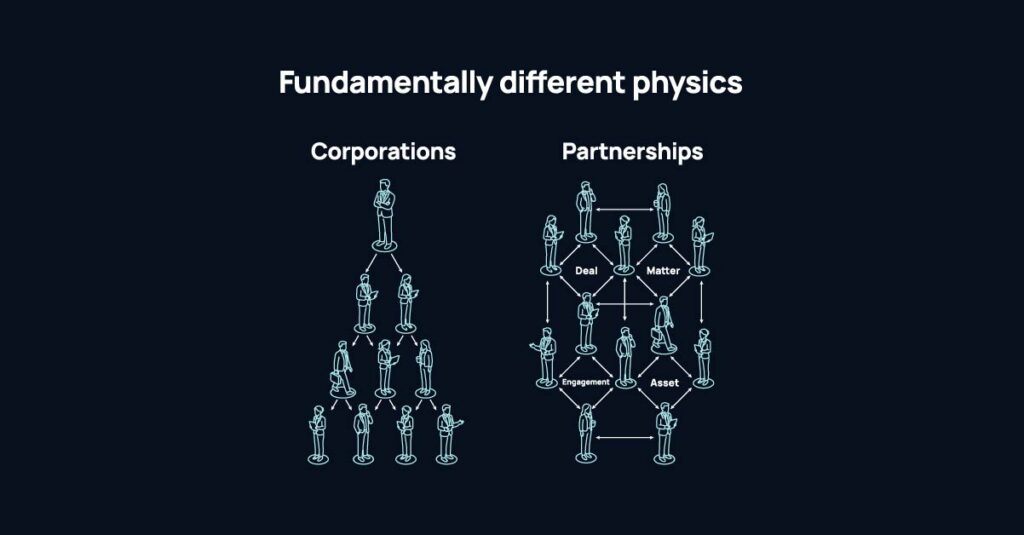
A firm differs from a corporation in two ways at once: its governance is partnership, not hierarchy, and its operating unit is the project, not the department. AI built for a company is blind to both.
A corporation can mandate. A partnership has to convince. And a firm’s work runs on projects, not departments. These facts shape how AI has to be built for a firm.
This holds at every scale, from an Am Law 100 firm with 1,200 partners to a private equity manager with 30. Professionals organize by expertise, not department, and each practice, sector, or strategy runs as its own business inside the firm, with its own clients or portfolio and its own economics. Partners own the firm, and they hold the relationships that bring in the work. They can walk, and when they do, they take entire practices, deal teams, or client books with them.
Firm AI cannot be installed. It has to be adopted. Adoption is not a rollout plan bolted on at the end. It is a property of the product.
There is no central switch a CEO or managing partner flips for the partnership. The software earns its place partner by partner, strategy by strategy, adapting to how each one already works rather than imposing a single firmwide model. Adoption is not a rollout plan bolted on at the end. It is a property of the product, and it is the first thing Horizontal AI, built for traditional corporations, gets wrong.
The second difference is just as important. A firm’s unit of work is the project, not the department. Deal teams assemble, diligence, negotiate, and disband. Matters get staffed, executed, billed, and closed. Funds raise, deploy, manage, and wind down. A firm is not a static org chart. It is a constantly re-forming network of project teams, each with its own members, obligations, and constraints.
So a Firm AI agent has to understand the project — deals, matters, engagements — not as a folder of documents, but as the unit that carries the rules of the work: its own access permissions, often complex and overlapping. Its own governance, what must be archived, retained, or turned into firm knowledge. Its own client, investor, and regulatory obligations. Its own economics, the margin or return it has to protect. All changing constantly as teams form and reshape.
None of this is uniform. Inside a single firm, a litigation matter and a regulatory investigation, a buyout and a private credit deal, an audit and a fund formation carry entirely different permissions, obligations, and economics. The firm runs dozens of operating models at once, one for every kind of work it does. An agent that applies a single logic to all of them gets all of them wrong, breaching a permission, missing a retention duty, or doing work the engagement was never scoped to pay for. Horizontal AI, seeing the firm as one undifferentiated business, has no idea there is anything to tell apart.
Firm AI starts from both realities. It respects the nudge, not the mandate. It orchestrates the project, not the department. It gives partners the autonomy they expect while giving the firm the oversight, guardrails, and accountability it requires. Many vendors trained on rollouts for other industries mistake this for a technology problem. It is not. It is how the firm is governed and how the work gets done. Firm AI is the only category built for the partnership and the project from the start.
Share your thoughts
For business professionals in professional and financial services firms who have long sought to harness the full power of the firm’s data, collective knowledge, processes, and judgment, this fundamental difference in how we think about AI for firms should resonate. If you have something to say about this, we would love to hear from you!
Next up
Next week we’ll talk about Principle 2: The business of the firm is the bigger AI opportunity.
In the meantime, the full argument is in the blueprint: Mind your business. Not just your practice.