This week in our series on the principles that Firm AI is built on, we cover the key to unlocking growth in professional and financial services firms: scaling the previously labor-intensive but critical business processes of the firm without adding overhead. How? With expert coworker agents.
Principle 5: Coworker agents are how that growth gets unlocked.
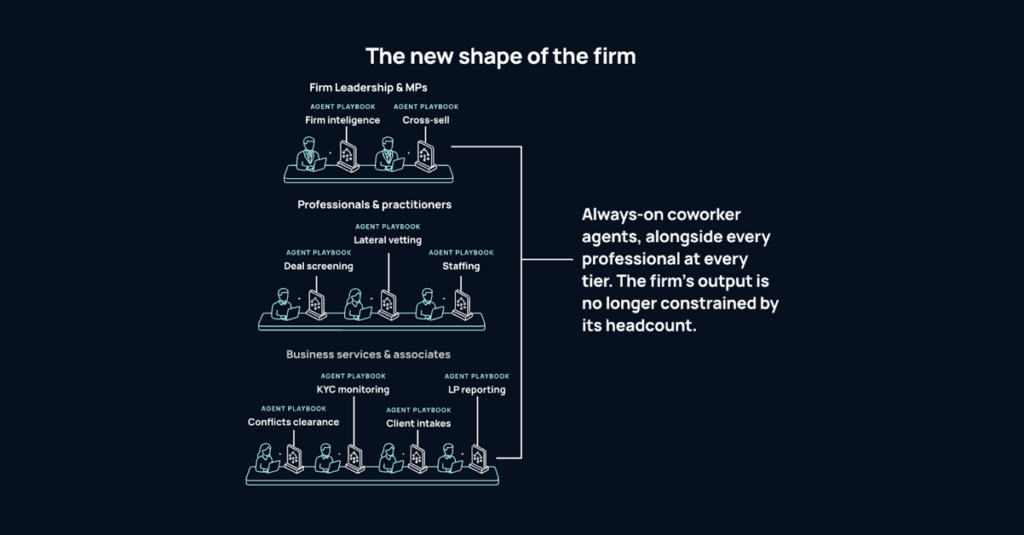
A general-purpose agent does many things adequately and nothing specifically. An expert coworker agent — built around the vocabulary, obligations, and workflows of a particular profession — does the specific thing the firm actually needs. A deal screening agent that knows what a quality-of-earnings flag looks like. A conflicts agent that walks a corporate tree the way a senior risk lawyer does. A lateral-hire vetting agent that compares a candidate’s book of business against the firm’s client roster, conflicts map, and cross-sell opportunities. In software, expertise has always come from specificity. The general agent is a generalist. The coworker agent is a colleague who already knows the work.
And it starts expert and stays expert. It needs no ramp: it arrives fluent in the work on day one. And it does not turn over. The hardest thing any firm function does is train a person, season them, and watch them leave. Expertise walks out the door every year. The agent does not. The senior partner who has the final say at the investment committee can now bring that scrutiny to every CIM that comes in, screened by an agent that has read every IC memo the firm has written, the deals pursued and the deals passed on, and flags what an experienced eye would catch.
Agents start expert and stay expert. They need no ramp: they arrive fluent in the work on day one. And they do not turn over.
A firm with a large IT team or a DIY culture may ask why it cannot build this directly on top of a model itself. It can build something. But encoding a firm’s vocabulary, obligations, and methods into a general agent is years of work from scratch, and that work is already done. Building instead of buying means spending those years getting to where the category already is.
This is the payoff of digital transformation that the first wave could only partially deliver. A decade ago, firms bought workflow tools that needed scaling numbers of data stewards and analysts to operate them. The cost compounded. The next wave is not that. An agent running the conflicts, intake, staffing, or LP reporting playbook does not need a salary, a benefits package, or a desk. It is a coworker that scales with the work.
The firm of 2030 will not have fewer professionals. It will have many more — multiplied by the expert coworker agents alongside them, each doing what a member of the business services team does, with the firm’s full institutional method backing every action. The partnership grows. The overhead falls. The throughput governors lift. The shape of the firm changes.
Next up
Next week we’ll talk about Principle 6: Professional compliance is a substrate; trust is what gets built on top of it. This is central to what makes Firm AI the right solution for professional services firms in particular. Compliance in the professional services industry is complex but critical. Firm leaders must be able to trust that access to sensitive data and essential processes will be properly preserved and protected.
In the meantime, the full argument is in the blueprint: Mind your business. Not just your practice.