For accounting and advisory firms, the most durable competitive advantage isn’t access to better AI models. It’s the ability to ground AI in the firm’s own context — from client relationships and engagement history to compliance obligation and institutional knowledge.
Firms that connect and govern this information are building an asset that accumulates over time — improving every engagement, informing every decision, and strengthening every independence check.
In our webinar, “Growth, redefined: Governed AI across the engagement lifecycle,” we explored how leading firms are putting this foundation in place — and where the real value of AI is starting to emerge.
The real differentiator is not the model
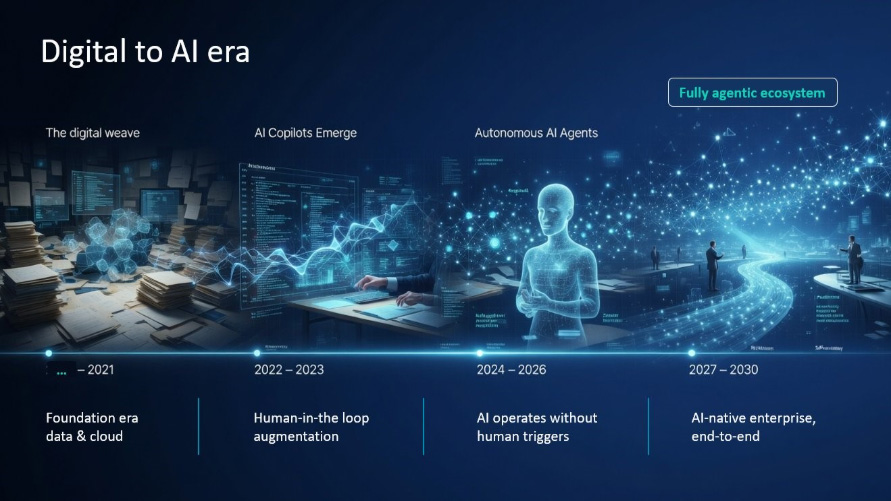
Tom Koehler, Global Managing Principal for Accounting and Consulting at Intapp, revealed that most firms are investing in the same AI tools: Microsoft Copilot, Anthropic, and OpenAI. On their own, these technologies are no longer a source of competitive advantage — they’ve become the baseline.
What differentiates firms now is how effectively they enable these tools to reason within proprietary context. Leading firms are strengthening data governance, making institutional knowledge accessible, and building the infrastructure that lets AI act on firm-specific logic rather than generic patterns.
With every engagement that flows through these systems, that advantage grows — becoming harder for others to replicate.
AI built in, not bolted on
The question firm leadership should be asking is whether the AI operating inside their firm understands how their firm works. Does it understand its client structures, independence requirements, engagement history, and compliance logic? Or is it reasoning from generic patterns and approximating the rest?
That level of understanding doesn’t happen by default — it must be engineered into general-purpose AI. The longer firms wait to start that work, the more they’ll incur in rework costs, risk exposure, and delayed ROI.
Introduced at Intapp Amplify 2026 and currently in limited release, Intapp Celeste is an agentic platform built for professional firms — where governance, firm context, and compliance logic are foundational rather than retrofitted.
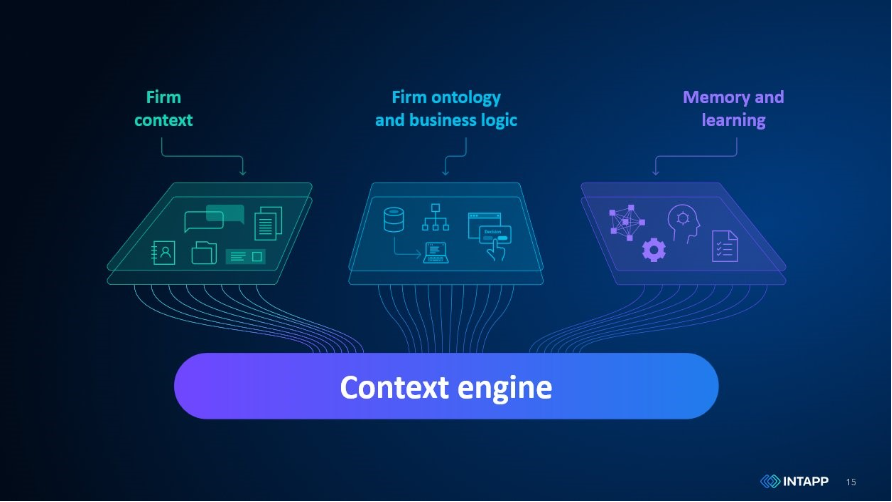
Celeste combines AI models from Microsoft Copilot, Anthropic, and OpenAI with Intapp’s domain expertise and client systems of record. Its context engine ingests firm ontology, business logic, and historical decisions, enabling AI agents to reason within a firm’s actual parameters, not approximate them. This means outputs are defensible, not just plausible.
Intapp Walls extends information barriers directly into AI-powered workflows. As AI operates across growth, compliance, and profitability processes simultaneously, access controls travel with the data rather than being managed after the fact.
DealCloud: When relationship capital walks out the door
In most firms, relationship capital lives in the heads of individual partners, not in shared systems. When a partner leaves, that information leaves with them. Because the loss doesn’t appear explicitly on balance sheets, firms often underestimate the impact.
The origination problem grows from there. Limited access to pipeline data concentrates business development insight in whoever knows how to pull data — which in turn concentrates origination in whichever partners carry the right relationships. And activity that isn’t logged disappears permanently. Every unrecorded interaction is institutional knowledge that the firm will have to rebuild from scratch.
Celeste changes this dynamic by allowing any stakeholder to query pipeline and relationship data conversationally. Rather than having to call a colleague or senior partner, the stakeholder can simply ask Celeste, “Who do we know at this target?” to uncover connections and accelerate business growth. Celeste’s Smart Tags also capture activity from emails and meeting transcripts automatically, so institutional knowledge accumulates in the firm’s systems and remains accessible over time
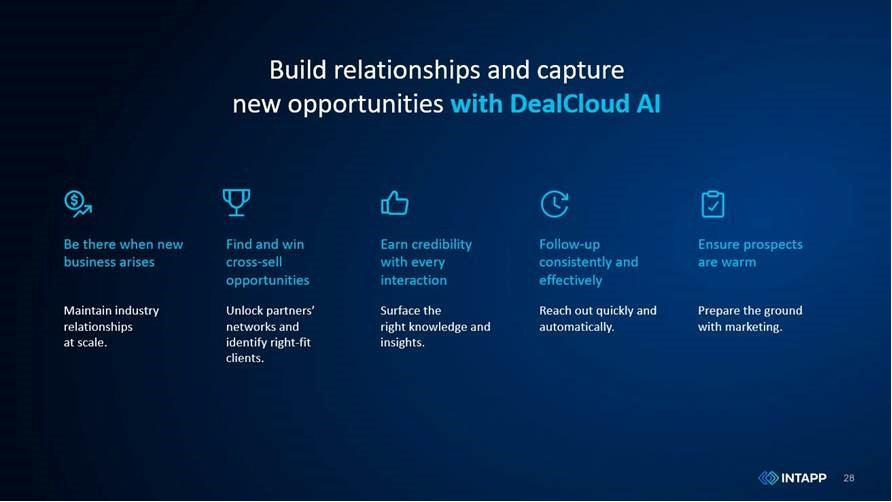
Firms with generic CRMs often find it constraining to configure these solutions, as every market shift or practice change requires unwinding custom code at precisely the moment speed matters most. This is a strategic agility problem that erodes a firm’s ability to adapt, scale, and compete.
Compliance: Keeping pace with AI-powered growth
AI is accelerating the front end of business development faster than compliance infrastructure was designed to handle. Many firms are still operating with risk processes built for a slower pace — and as deal flow speeds up, those processes become a constraint on revenue.
Firms that haven’t modernized often feel pressured to cut corners so they can keep up — but often cut corners in the exact places where errors carry the highest professional consequences.
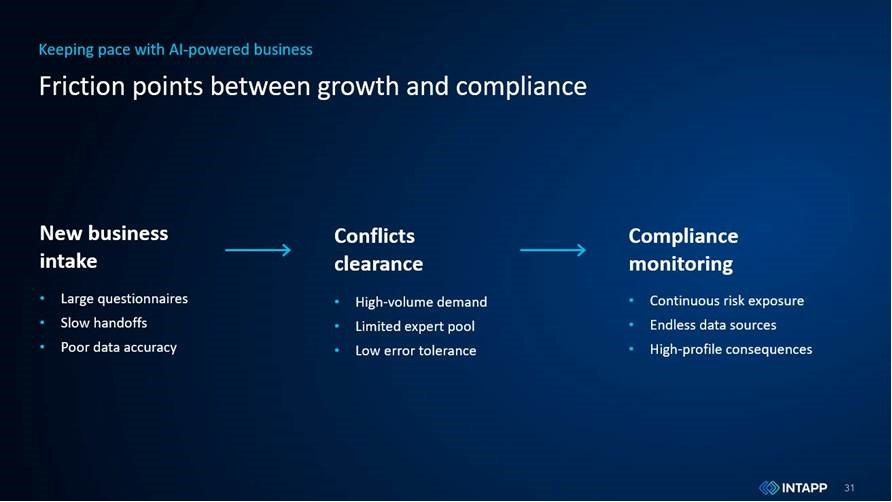
Intapp Intake addresses this problem upstream. Using AI, it extracts key details from shared files to pre-populate requests and flag data gaps before submission. Instead of incomplete submissions and multiple follow ups, compliance teams receive complete, structured information — reducing delays and accelerating time to revenue.
Intapp Conflicts automates the pre-analysis work that consumes analyst capacity — from constructing search strategies and building corporate trees, to matching aliases and querying connected data sources like Intapp Data, Dun & Bradstreet, and Moody’s. Analysts no longer need to spend hours on preparation work, and they have more time to review high-risk hits — which the platform automatically escalates for expert judgement. Every outcome can also be accompanied by a generated summary of the analysis and decisions, creating a documented record that supports consistent, defensible decision-making.
The most underestimated risk isn’t incomplete diligence during onboarding — it’s what happens after. Client circumstances change through ownership transfers, M&A activity, sanctions additions, or adverse media. Firms often miss this data because monitoring is manual and periodic. Agentic AI makes continuous monitoring operationally viable at the portfolio level in a way that manual processes can’t.
The compounding advantage
AI is only as good as the context behind it. And for accounting and consulting firms, that context is everything. It’s your client relationships, your engagement history, your methodology, and your obligations.
HALEY KERSTETTER, MANAGING DIRECTOR FOR ACCOUNTING, INTAPP
Firms that want to win must do more than invest in top-tier AI models. Without the right underlying input, their firm’s AI will underperform, regardless of how advanced the tool is.
The firms building context into their systems are building an accumulating advantage. Every engagement, every cleared conflict, and every compliance decision strengthens a firm’s institutional knowledge and makes every future AI output more accurate and defensible.
But the window to build this foundation is narrowing. If your firm wants to pull ahead of competitors, you’ll need to act fast.
Watch the on-demand webinar to learn more about how leading firms are approaching governed AI across growth, compliance, and the engagement lifecycle.