
Discover the future of Firm AI for the business of law
See how Intapp Celeste brings Firm AI to life as the operating layer for professional firms.
· 4 min read
Recently, Accounting Today hosted an in-depth panel discussion featuring Tom Koehler (Intapp) and Stuart Ferguson (Pointe Advisory), moderated by Michael Green (Accounting Today). The session explored findings from Accounting Today’s latest research survey and examined how private equity (PE), capital strategy, and AI adoption are transforming the accounting industry.
This recap summarizes the research objectives, survey insights, and expert commentary to help firms understand the link between private equity activity, AI investment, and long-term strategic planning.
Michael Green opened the discussion by outlining the primary goals of the research: to identify the capital needs of accounting firms and to assess how PE investment supports growth, technology modernization, and AI integration.
The study surveyed 304 professionals across firm sizes. Respondents highlighted that PE partnerships are increasingly viewed as a strategic path to fund technology transformation, strengthen governance, and competitively scale operations.
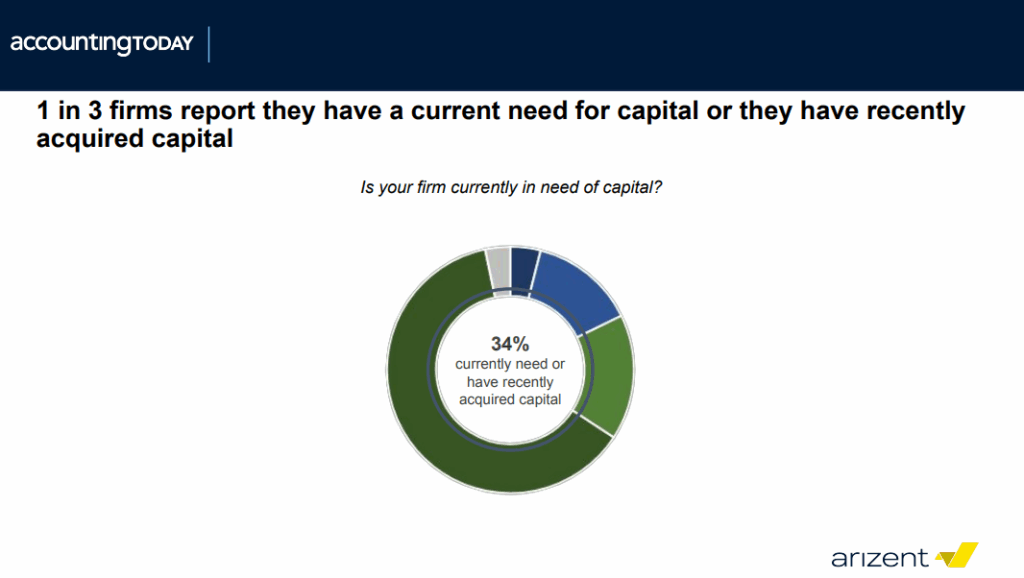
Although two-thirds of surveyed firms indicated no immediate capital needs, panelists agreed that this will shift quickly within the next 12 to 24 months.
Tom Koehler noted that rising demand will be driven by strategic opportunities, technology investment requirements, and demographic pressures rather than financial distress.
Stuart Ferguson emphasized recapitalization for succession planning as a key challenge. Many firms cannot manage retirements or generational transitions without external funding. On this point, Stuart said:
“It is really hard to do deals at current valuations if you do not have an outside pool of capital.”
Both speakers observed that the market is dividing between firms that can invest proactively in technology, including AI, and firms that are forced to respond reactively to competitive pressures.
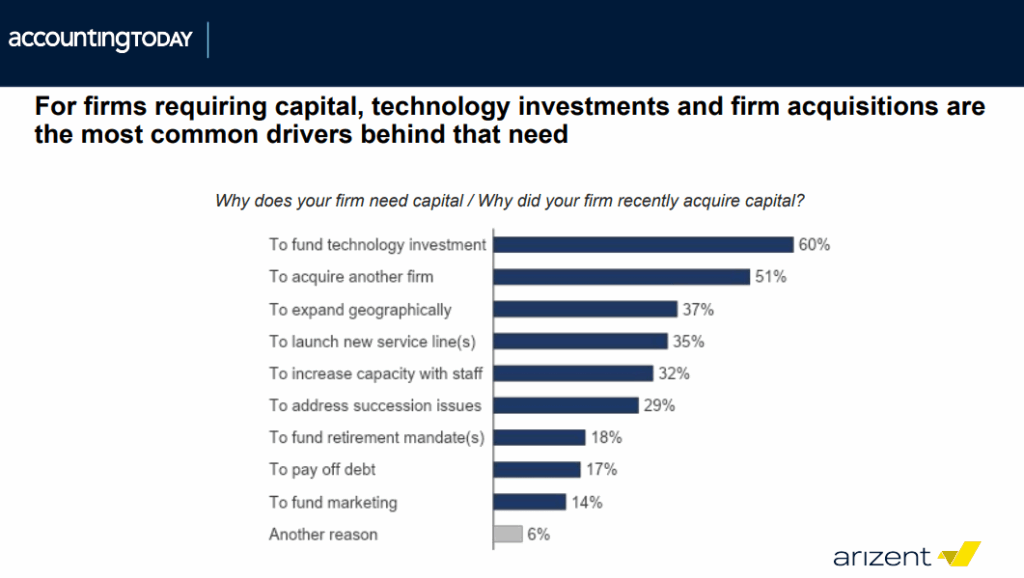
The survey identified specific reasons firms seek external capital:
Stuart emphasized that technology investment, especially in AI, is increasingly a necessity for firms seeking to maintain competitiveness.
Tom noted key differences across market segments:
Panelists identified three forces driving increased capital needs:
Tom emphasized that governance alignment is critical.
“Your capital strategy should serve and amplify your commercial strategy,” Tom clarified.
The panelists highlighted that private equity now provides more than capital. PE partners deliver operational expertise, modernization frameworks, and technology resources that help firms scale intelligently.
Tom described PE as a source of patient capital that enables innovation beyond the limitations of traditional partnership structures.
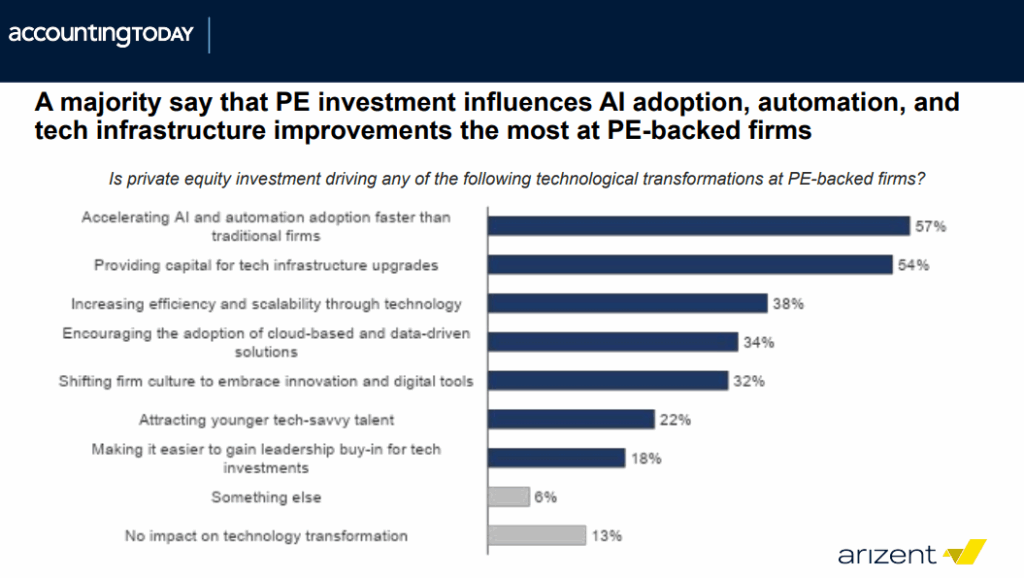
Stuart noted that PE-backed firms are better prepared to invest in AI platforms, data infrastructure, and M&A integration to meet competitive challenges.
As PE investment accelerates, firms can expect to see:
Tom predicted that capital deployment will shift toward technologies that enable revenue growth, with AI playing a central role in that shift.
Firms evaluating PE partnerships or planning for technology transformation should prioritize:
The growing influence of private equity and AI adoption across accounting firms was reinforced throughout the webinar. Capital is becoming a strategic enabler that supports modernization, talent strategy, and competitive differentiation.
As demographic shifts, technology pressures, and client expectations accelerate, proactive investment will be essential. The insights shared by Tom, Stuart, and Michael offer a clear roadmap for firms preparing to navigate this period of industry transformation.
From the blog

Global Managing Principal, Accounting and Consulting
This Q&A with Intapp’s Tom Koehler shares how Firm AI helps accounting and consulting firms address margin pressures, talent shortages, and other challenges.
Count the days between partner approval and a signed engagement letter. See where accounting firms lose time in intake, conflicts, and independence checks.
Carr, Riggs & Ingram M&A Advisors selects Intapp DealCloud with Celeste to apply governed, agentic Firm AI to its mergers, acquisitions, and deal management processes.
Private equity is changing accounting firms by introducing external capital, structured governance, and growth-focused operating models. PE-backed firms can invest in AI technologies, expand advisory services, and pursue acquisitions at a scale that traditional partnership models often struggle to support.
Firms are seeking capital to address succession transitions, hire and retain talent, and fund technology investments including AI. Rising competitive pressure and demographic shifts are pushing firms to adopt more sophisticated capital strategies to stay competitive.
AI enables automation of core workflows, advanced analytics, and improved client delivery models. PE-backed firms often accelerate AI adoption because the technology increases efficiency, enhances profitability, and supports scalable service offerings.
Large firms typically deploy capital offensively to build AI-enabled platforms, pursue acquisitions, and expand service lines. Mid-sized firms use capital defensively to address staffing shortages, capacity constraints, and succession challenges.
Key indicators include succession planning pressure, limited technology budgets, delayed AI adoption, stalled M&A opportunities, or the need to scale advisory services. Firms facing capacity constraints or competitive erosion often benefit from PE-backed growth strategies.

