
Discover the future of Firm AI for the business of law
See how Intapp Celeste brings Firm AI to life as the operating layer for professional firms.
· 5 min read

Director of Engineering
Enterprise agent adoption has surged over the past six months and is expected to keep accelerating. Governance hasn’t kept pace: Only one in five say they have the right infrastructure to support broader agentic adoption.1 That gap carries big risks. Gartner predicts that more than 40% of agentic AI projects will be canceled in 2027 because of costs and risk control, rather than AI capabilities.
Both problems start in the infrastructure around the model, and a harness is where firms can address them.2
An agent harness is the runtime layer that wraps around a large language model (LLM) and governs how an agent uses the LLM. It manages the context, memory, tools, and rules an agent works with.
As firms move from piloting agents to running them at-scale, the foundation they choose shapes both cost and control. Here’s how two approaches to that foundation compare:
The Celeste harness sits between the chat application and the LLM:
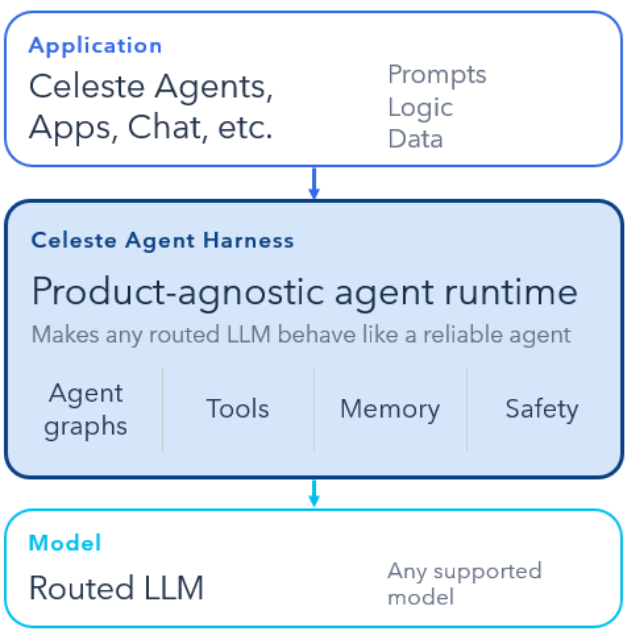
One rule keeps the harness clean: If removing any Intapp product or database would break the code, it doesn’t belong in the harness. The harness encodes your firm’s rules and context without creating dependencies on specific products or underlying data.
Running a question through the harness changes the response in two ways:
The harness is built for end-to-end workflows, with five components behind it:
Every tool call, retrieval, and summary an agent makes will run through Celeste compliance checks automatically. If something fails a check, it doesn’t happen. For higher-stakes actions, the harness can pause a tool call and require human sign-off before execution. That’s what makes Celeste viable for the most regulated industries in the world.
The harness builds in firm-specific judgment at the same control point. Harness blueprints tune what the agent knows and how it behaves for your firm, layered on top of defaults grounded in decades of industry knowledge. Every firm-specific change is versioned and reviewed before it goes live, keeping specialization consistent and controlled.
Underneath, the harness guides the agent with reminders at each decision point, hooks that can adjust inputs before reaching the model, and wrappers that can stop or redirect a tool call before it runs.
The Celeste harness gives your firm three advantages:
Together, these advantages address the cost and risk concerns that threaten agent projects, and they give your firm a foundation to build on as agentic adoption grows.
Sources:
1 Deloitte (2026). The state of AI in enterprise. https://www.deloitte.com/us/en/what-we-do/capabilities/applied-artificial-intelligence/content/state-of-ai-in-the-enterprise.html
2 Gartner, Inc. (2025, June 25). Gartner predicts over 40% of agentic AI projects will be canceled by end of 2027 [Press release]. https://www.gartner.com/en/newsroom/press-releases/2025-06-25-gartner-predicts-over-40-percent-of-agentic-ai-projects-will-be-canceled-by-end-of-2027
From the blog

Value Engineer
Test your law firm business case before and after go-live. Learn how to measure AI ROI for law firms and the questions to ask before you sign.

Vice President, Product Management
Warren Knowles answers firms’ top questions about Intapp Celeste and Firm AI: which models it uses, what it can access, and where a person decides.

Global Managing Principal, Accounting and Consulting
This Q&A with Intapp’s Tom Koehler shares how Firm AI helps accounting and consulting firms address margin pressures, talent shortages, and other challenges.